
History
About - History of the Liberal Party
More information about the history of the Liberal Party is available on the Liberal Party website, but I have included below specific Liberal party history relevant to my portfolios. Click the + sign to learn more about each of these.
-
The Liberal Party has long advocated for Aboriginal and Torres Strait Islander people. We were responsible for the 27 May 1967 referendum which, repealed section 127 of the Constitution which allowed Indigenous Australians to be counted in the Census; and added section 51(xxvi) which allowed the Commonwealth to make laws in relation to Aboriginal and Torres Strait Island people. This major change gave Aboriginal and Torres Strait Islanders equal status as Australian Citizens under the Constitution. Source: https://en.wikipedia.org/wiki/1967_Australian_referendum_(Aboriginals)
It was the Liberal party under The Hon Malcolm Fraser which established the Aboriginal Development Commission (ADC) as a statutory authority in July 1980 with a Board consist of 10 members, all Aboriginal, and the new body would employ around 100 people, mostly Aboriginal. The legislation also gave statutory recognition of the National Aboriginal Conference, which was made up of Aboriginal people elected in 35 electorates across Australia, which canvassed the opinions of Aboriginal people across Australia and reported them to the Minister for Aboriginal Affairs.
In 1990, Labor transitioned these functions into the Aboriginal and Torres Strait Islander Commission. Unfortunately in 2004, both the Liberal government and the Labor opposition concluded that because of a number of controversies that ATSIC could not be continued.
Since 2004, there have been a variety of mechanisms tried to ensure the views of Aboriginal and Torres Strait Islanders are given appropriate consideration in the deliberations of government. Current arrangements
In 2004, the Canberra Liberals supported the establishment of the Aboriginal and Torres Strait Islander Elected Body saying this aligned with the Party’s values and commitment to empowering Aboriginal and Torres Strait Islander communities through self-determination and representation, and ensuring their voices are heard in government decision-making processes.
In 2024, I and many of my Canberra Liberal colleagues supported the Yes campaign for the Voice to Parliament, recognising that in Canberra, we already have a voice to the Legislative Assembly.
-
History of Liberal Party in relation to Migration
Visit the Department of Home Affairs website for a detailed exploration of Australia’s immigration history
Since its establishment on 16 October 1944, on principles reflecting progressive nineteenth century free enterprise and social equality, the Liberal Party of Australia has had a proud history of repealing the White Australia Policy and in the creation of the modern multicultural Australia.
The principles underpinning our approach reflect the commitments in the Global Compact for Safe, Orderly and Regular Migration.
This Global Compact recognizes that safe, orderly and regular migration works for all when it takes place in a well-informed, planned and consensual manner.
We believe that we must empower migrants to become full members of our societies, highlight their positive contributions, and promote inclusion and social cohesion. We consider that inclusion and cohesion are appropriately supported by use of English as a common language.
We believe that safe, orderly and regular migration involves adjustments to migration levels when necessary to respond to the needs of the community and the economy, but also reflect the aspirations of migrants for family reunion and freedom of travel. We believe that Australia has an important role in providing durable solutions for refugees and asylum seekers, which is best done through the auspices of the UNHCR, with Australia providing durable resettlement options for the most vulnerable refugees.
We fundamentally believe in a free and open society where all citizens are equal, regardless of their origins or beliefs.
Key milestones:
Prior to the establishment of the Liberal Party, Australia had an official policy of only allowing migration of white Europeans. This policy, known as the White Australia Policy empowered immigration officials to conduct a ‘Dictation Test’ in any European language, which was used selectively to exclude non British migrants.
1950 – Liberal Immigration Minister Harold Holt made the historic decision to allow 800 non-European war refugees to remain in Australia.
1958 - The Liberal Party revised the Migration Act 1958 to introduce a simpler system of entry permits and abolishes the controversial Dictation Test.
1966 – Hubert Opperman, Liberal Minister for Immigration, announces that applications from prospective settlers will be considered on their suitability as settlers, their ability to integrate readily and whether they have qualifications useful to Australia. It's effectively the end of the White Australia Policy.
1973 – By the time Multiculturalism was formally adopted in 1973, thousands of Asian immigrants had already been allowed into the country by Liberal governments.
1976-1982 – Prime Minister Malcolm Fraser allows Vietnamese boat people to settle in Australia, and supports the resettlement of over 200,000 more refugees whose claims are processed in camps in Malaysia, Hong Kong and Thailand.
1977 – The Australian Ethnic Affairs Council was appointed to advise the Liberal Government of Malcolm Fraser. It recommended a public policy of multiculturalism in its report Australia as a multicultural society
1978 – The Liberal Government of Malcolm Fraser implemented the first official national multicultural policies.
1979 – The Liberal Government of Malcolm Fraser introduced an Act of Parliament establishing the Australian Institute of Multicultural Affairs (AIMA). Its objectives included raising awareness of cultural diversity and promoting social cohesion, understanding and tolerance.
1989 – The Liberals in opposition supported the Labor Government of Bob Hawke’s National Agenda for a Multicultural Australia.
1992 – the Liberal Party supported a Labor Government decision to introduce mandatory detention for all people arriving without a valid visa. This was in response to increasing numbers of people using people smugglers to arrive by boat and was considered necessary to manage the processing of visas.
Public policy on asylum seekers coming to Australia by boat has been a hotly contested political issue for many elections. The Liberals policy has been true to our beliefs reflected in the Global Compact for Safe, Orderly and Regular Migration. We believe that the orderly migration of refugees is best achieved through the United Nations High Commissioner of Refugees (UNHCR) conducting assessments of refugee status and prioritising individuals for third country resettlement based in individual circumstances and need. We consider that Australia should accept high risk refugees who face continued persecution in refugee camps, vulnerable women and children. We believe that allowing irregular migration flows undermines the work of the UNHCR and that our policies should discourage such irregular flows.
1996 – The Liberal Government of John Howard endorsed the Parliamentary Statement on Racial Tolerance
1997 – The Howard Government announced a new National Multicultural Advisory Council (NMAC).
1999 – The Howard Government launched NMAC's report, Australian Multiculturalism for a New Century: Towards Inclusiveness
2001 – The Howard Government denied permission for the Norwegian vessel the MV Tampa to enter its waters after rescuing 438 mainly Afghan refugees from a stranded boat off Christmas Island. That decision reflected the governments interpretation of the United Nations Convention on the Law of the Sea that vessels rescuing individuals in international waters continue to their planned destination.
Subsequent Liberal Governments supported, established and developed what has become known as the 'Pacific Solution', where irregular asylum seeker arrivals cannot automatically apply for an Australian visa and may be returned to a country they entered in transit to Australia or processed at an offshore processing centres. These policies have been supported by Labor.
2002 - marked a significant milestone in Australia's citizenship laws with the introduction by the Howard Government of the Australian Citizenship Act 2002. This legislation formally recognized and permitted dual citizenship, a move that reflected the changing demographics and global mobility of the Australian population.
May 2003 – The Howard Government released its multicultural policy statement, Multicultural Australia: United in Diversity
In 2005, reflecting our concern for individuals suffering hardship while waiting for a refugee visa decision, the Howard Government introduced the Community Care Pilot (later changed to the ‘Community Assistance Support’ or CAS program) for people who became vulnerable during their migration journey (including ‘forced migration’) and could not meet their basic needs while waiting for their visa application to be finalised.
In the same year, reflecting our concern for individuals for whom detention in a processing centre was inappropriate, the Howard Government introduced community detention (now called a ‘residence determination’). This meant that a person who did not have a visa could leave a detention facility and live in a specified residence in the community.
October 2016 – The Turnbull Liberal Government formally reaffirmed its commitment to racial respect. In the House of Representatives, it moved a statement on equal rights
March 2017 – The Turnbull Government released the statement, Multicultural Australia – united, strong, successful
2019 - In response to concerns that there were long delays in applications for Parent and Family migration visas, Liberal Immigration Minister Scott Morrison introduces Sponsored Family migration visas. This allowed an increase in Family and Parent migration without causing a financial burden to Australian taxpayers.
2025 – The Liberal Party under Peter Dutton took policies to the 2025 Commonwealth election to address the challenges of high cost of living and the lack of affordable housing. Part of that strategy involved temporary reductions in immigration numbers until such time as the economy recovered. That policy was non-discriminatory, consistent with the Global Compact for Safe, Orderly and Regular Migration and sought to provide a balance to the needs of both existing Australians and potential new migrants.
“"...[W]hat we must look for, and it is a matter of desperate importance to our society, is a true revival of liberal thought which will work for social justice and security, for national power and national progress, and for the full development of the individual citizen, though not through the dull and deadening process of socialism”
— Robert Menzies, 1944
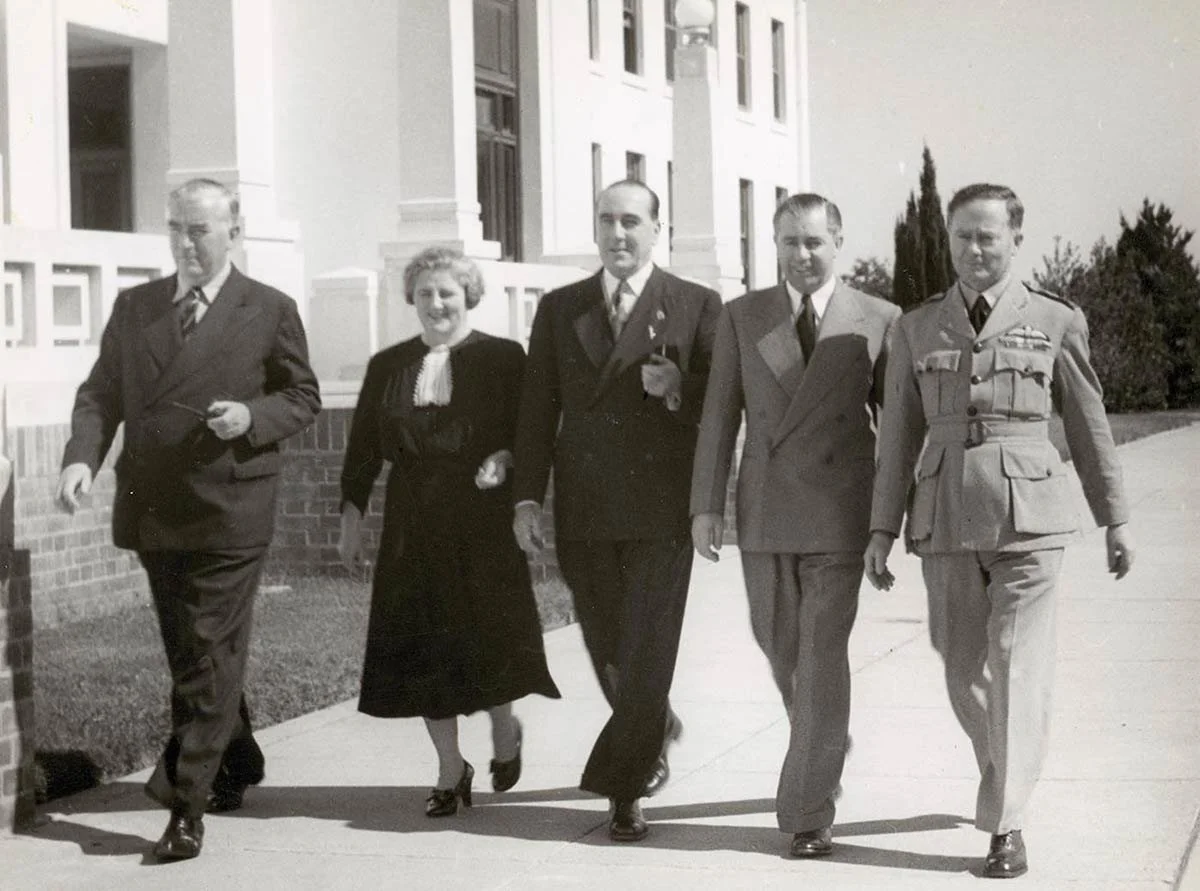
From left: Robert Menzies, Dame Enid Lyons (first woman member of an Australian cabinet), Sir Eric Hansen, Harold Holt (Menzies’ successor), and Tom White (first federal president of the new party) in 1946